Cracking the Cold Case: How to Read a Beer Label Like a Freshness Detective
Photo: Shixart1985, CC BY 2.0, via Wikimedia Commons
There are two kinds of beer drinkers: those who check the date on a can and those who trust the bottle shop's fluorescent lighting. The second group is charming, optimistic, and occasionally drinking a hazy IPA that was packaged when the store still had a 2024 calendar. A beer label is a tiny legal document wearing a Halloween costume. The date info is usually there, but it is hiding near the bottom rim, under the barcode, or in a dot-matrix font that looks like a receipt from a haunted deli.
You do not need a decoder ring. You need a little patience, a phone flashlight, and the willingness to look like a weirdo in aisle seven. Welcome to freshness detective work, ninja style.
First, Accept That the Label Is Not Your Friend
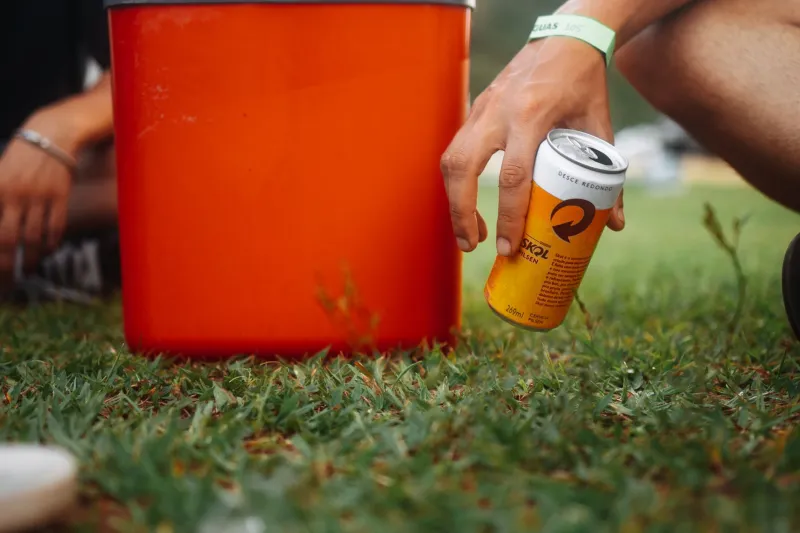
Most labels want to sell you a vibe: a mountain, a mermaid, a laser wolf, a slogan about crushing it. The date code wants to tell you the truth, but it has been shoved into a corner. It might be printed on the neck, stamped on the bottom, dot-matrixed under the barcode, or lasered somewhere that requires you to tilt the can like you are reading a treasure map.
This is not personal. It is packaging. Breweries deal with state labeling rules, canning line quirks, and the fact that ink smudges. Your job is not to solve every mystery. Your job is to notice when there is enough information to make a better choice.
The Four Date Dialects You Will Meet
Bottled-on or packaged-on
This is the gold standard: the beer's birthday. If a can says packaged on 16 October 2026, you know exactly how old it is. For hop-forward beers, that matters. Many US craft IPAs are at their best within roughly 30 to 60 days of packaging, though plenty of brewers would argue about the exact window. Crisp lagers and pilsners also reward freshness. A packaged-on date lets you decide instead of guess.
Best by or enjoy by
A best-by date is a window, not a birth certificate. The brewery is telling you when it thinks the beer is at its peak, or at least still worth your money. That is useful, but it is not the same as knowing the packaging date. A best-by date can be conservative, optimistic, or based on a style that was never meant to be cellared. Treat it as a strong hint, not a courtroom exhibit.
Julian codes
This is where the ink gets cryptic. You will see a four- or five-digit string that looks like a locker combination. Often it includes the year and the day of the year: something like 26045 would mean the 45th day of 2026, which is 14 February. Sometimes the order is different. Sometimes there is a batch number mixed in. Sometimes the code is really just a brewery internal riddle.
If you see a code beginning with 26 in 2026, that is a clue. It is not a guarantee. When in doubt, ask the brewery or the shop. A good bottle shop should know how to read the codes on its own shelves.
No date at all
Some labels give you nothing. No packaged-on, no best-by, no helpful little numbers. This is not automatically a crime. Small breweries have limited canning lines, and some brands use batch codes that only make sense internally. But a missing date does mean you have less information. In that case, ask questions, check the cooler, or buy a single can instead of a four-pack. Caution is a valid flavor.
Which Beers Reward Freshness and Which Wear Wrinkles Well
Freshness is not one universal rule. It is a style-by-style conversation.
Hop-forward beers are the impatient ones. IPAs, pale ales, hazy IPAs, fresh-hop beers, and anything built around citrus and pine tend to lose their sparkle as the weeks pass. They do not become dangerous, but they can become dull, sweet, or vaguely like a stale fruit salad. If you are spending craft-beer money on a hazy IPA, you want the bright version.
Crisp lagers, pilsners, wheat beers, and many session ales also do well young. These styles are not usually improved by months of shelf time. They are built on clean fermentation and fresh malt character, and they taste better when they have not been sitting under a warm display light since spring.
Some beers can handle age. Barrel-aged stouts, barleywines, Belgian strong ales, and certain mixed-fermentation sours can develop interesting notes over time. But storage matters more than the style label. A barleywine kept cool and dark for a few years can be a lovely thing. The same bottle baking on a sunny shelf is a sad raisin in a glass bottle. High alcohol is not automatic permission to age a beer. It is just one factor.
The Shelf-Side Interrogation Without Sounding Like a Beer Cop
You are allowed to ask questions. You are not allowed to turn a bottle shop into a deposition. The trick is to sound curious, not accusatory.
Try: What came in fresh this week? Do you know the packaged date on this batch? How often do you rotate the IPAs? Is this stored in the cooler or out here? These are normal retail questions. Staff who care about beer will appreciate them. Staff who do not will give you a shrug, and that shrug is also information.
Do not march up to the counter and announce that the store is committing freshness crimes. That is how you become a legend for the wrong reason. A ninja gathers intel quietly. A ninja also knows when to just buy a different beer.
Red Flags That Whisper, Not Shout
A dusty shoulder on a bottle is not proof of anything, but it is a nudge. A faded label, a sunlit window display, a warm shelf full of hazy IPA, or a build-your-own six-pack with no dates anywhere are all reasons to slow down. Clearance IPAs can be fine, but they are rarely the freshest thing in the building. Use judgment. A single red flag is a question. A pile of red flags is a suggestion to walk away.
The Ninja Move: Buy Small, Taste Fast, Store Cold
If you are unsure, buy one can. Taste it. If it is lively and bright, go back for more. If it is flat and tired, you have lost one can instead of committing to a whole sad four-pack. Store beer cold when you can, keep it away from light, and do not freeze it unless you are conducting a very specific and probably regrettable experiment.
Date codes are not fortune-telling. They are clues. Learn the dialects, ask a calm question or two, and let freshness be one part of your buying decision instead of a label-based panic attack. The best bottle in the shop is often the one with a date you can actually read and a style that belongs in your glass soon.